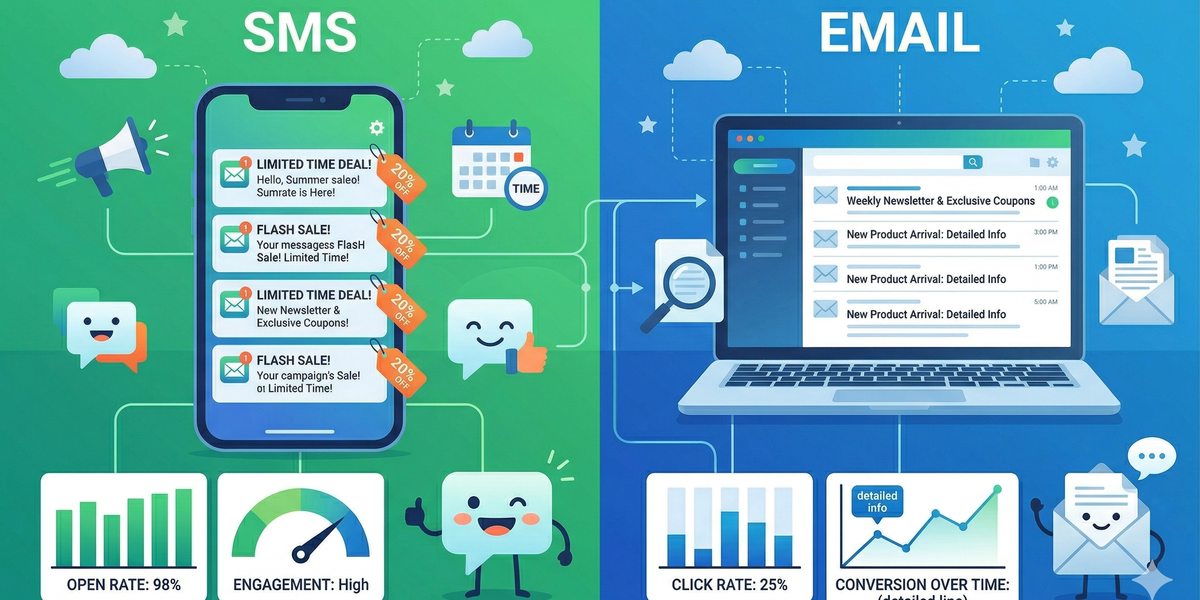
When it comes to digital marketing, businesses often ask: Should I use SMS or email marketing?
Both channels are powerful, but they serve different purposes. Understanding the strengths of each can help you choose the right strategy for your business.
In this guide, we compare SMS and email marketing and explain when to use each.
What is SMS Marketing?
SMS marketing involves sending text messages directly to customers’ mobile phones. These messages are typically short, immediate, and highly visible.
Businesses use SMS for promotions, alerts, reminders, and time-sensitive updates.
What is Email Marketing?
Email marketing involves sending messages to customers’ email inboxes. Emails can include longer content, images, and detailed information.
Businesses use email for newsletters, promotions, product updates, and customer communication.
SMS vs Email: Key Differences
Here are the main differences between SMS and email marketing:
Delivery Speed SMS is delivered instantly, while emails may be delayed or filtered into spam folders.
Open Rates SMS messages have significantly higher open rates compared to email.
Message Length SMS is short and direct, while email allows longer, detailed content.
Engagement SMS usually gets faster responses, while email is better for detailed communication.
When to Use SMS Marketing
SMS is best for:
• Flash sales and limited-time offers • Appointment reminders • Delivery notifications • Urgent updates • Customer alerts
Because SMS is immediate, it works best for time-sensitive communication.
When to Use Email Marketing
Email is best for:
• Newsletters • Product updates • Detailed promotions • Educational content • Long-form communication
Email allows businesses to provide more information and visuals.
Combining SMS and Email
The best strategy is often to use both channels together.
For example:
• Send an email with detailed information • Follow up with an SMS reminder
This approach increases visibility and improves overall campaign performance.
Why SMS is Growing Faster
Many businesses are shifting towards SMS because:
• Customers check their phones frequently • Messages are not filtered like emails • Faster engagement and response rates • Better for mobile-first users
SMS is becoming a key channel for modern business communication.
Using DataFlows for SMS Campaigns
With DataFlows SMS, businesses can:
• Send bulk SMS campaigns • Create contact lists • Personalise messages using tags • Schedule campaigns • Integrate with APIs and platforms
This makes it easy to include SMS in your marketing strategy.
Conclusion
Both SMS and email marketing are valuable tools, but they serve different purposes. SMS is best for fast, high-impact communication, while email is ideal for detailed messaging.
For the best results, businesses should combine both channels and use each where it performs best.